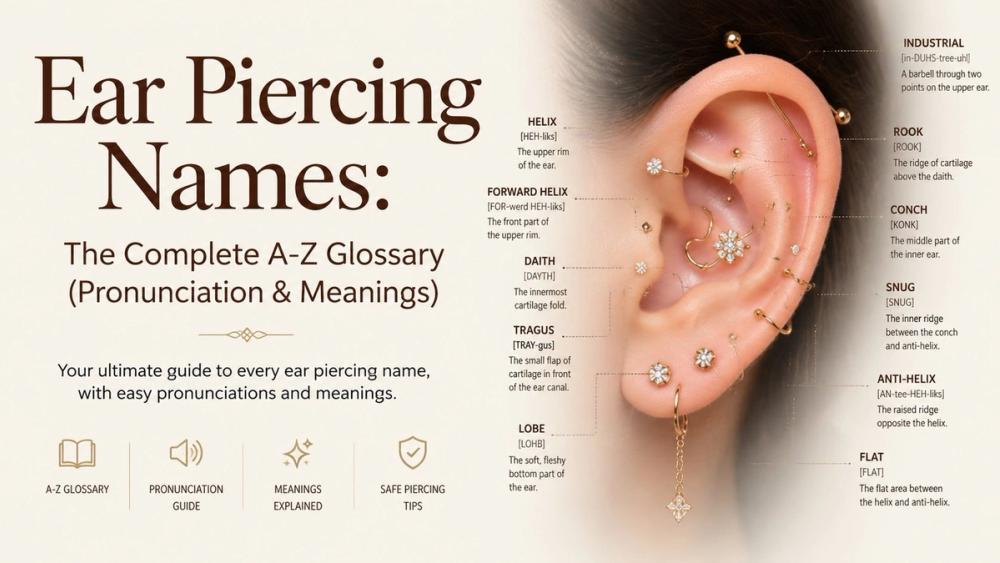
If you have ever scrolled a studio booking page and felt lost between a "daith," a "rook," and an "industrial," you are not alone. This guide is your plain-English dictionary of ear piercing names the official anatomical terms , the nicknames you will hear in studios, how to actually say them, and exactly what each placement is. Bookmark it before your next appointment.
Why Ear Piercing Names Get So Confusing
Most ear piercings are named after the part of the ear they pass through the tragus, the helix, the conch , and so on. The trouble is that the same spot often has two or three names: a clinical one, a salon one, and a regional one. A "scaffold" in the UK is an "industrial" in the US. What one artist calls a "snug" is technically an anti-helix. Knowing both saves you from miscommunication and from booking a piercing you did not mean to get.
Below, we have sorted every common ear piercing name into one A to Z glossary so you can match the word to the spot.
The Complete Ear Piercing Name Glossary (A to Z)
A - Anti-Tragus & Anti-Helix
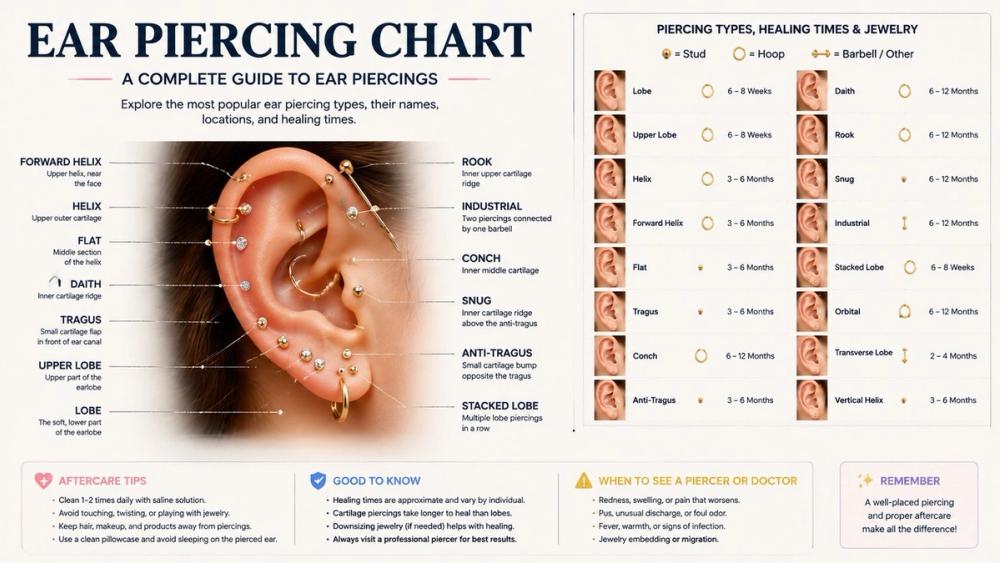
- Anti-Tragus - the small bump opposite the tragus, on the lower outer ear. Often called a "snug" when pierced horizontally through the cartilage fold.
- Anti-Helix (a.k.a. Snug) - the curved ridge inside the outer rim. A snug piercing runs through this fold; it is one of the slower-healing cartilage spots.
C - Conch
- Conch - the large cup-shaped area in the middle of the ear. Split into inner conch (center) and outer conch (toward the rim); both are popular for hoops and studs.
D - Daith & Dermal Anchor
- Daith - the small piercing tucked into the cartilage where the inner ear meets the face, near the ear canal. Pronounced "doth" or "day-th."
- Dermal Anchor (a.k.a. Microdermal) - a single-point surface anchor, not a through-piercing. Less common on the ear but used on the flat.
F - Forward Helix
- Forward Helix - the cartilage at the front of the upper ear, closest to the face. Often done as a double or triple for a stacked look.
H - Helix & Hidden Helix
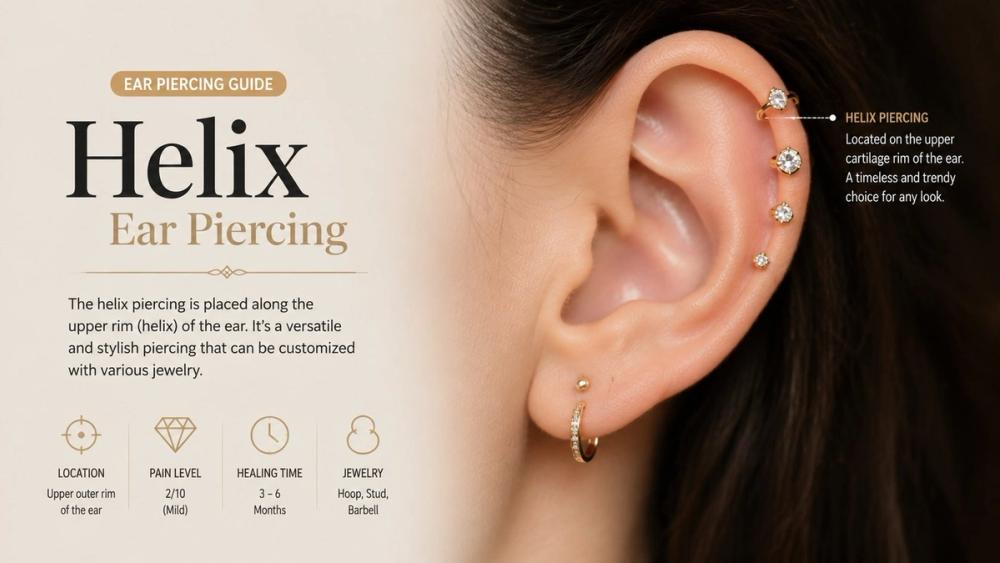
- Helix - the classic rim piercing along the outer top edge of the ear. The single most popular cartilage piercing.
- Hidden Helix (a.k.a. Faux Snug) - sits just inside the rim, mimicking a snug without crossing the full fold.
I - Industrial
- Industrial - two holes connected by one long barbell, usually through the upper helix and forward helix. In the UK it is often called a "scaffold."
L - Lobe (Standard, Upper, Double & Triple)
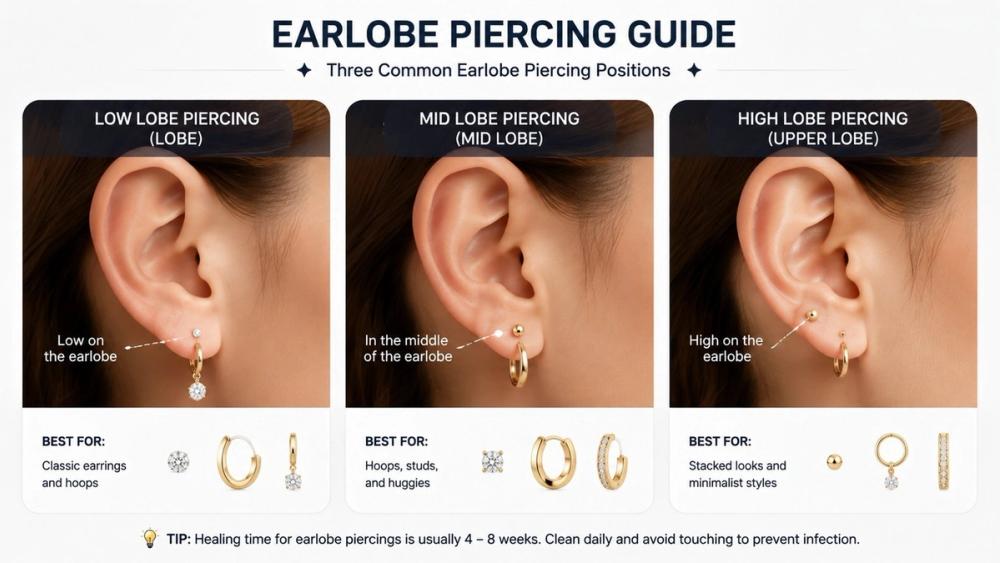
- Lobe (Standard) - the soft lower earlobe; the gentlest, fastest-healing option and the usual first piercing.
- Upper Lobe - higher on the lobe, just below the cartilage.
- Double / Triple Lobe - two or three evenly spaced lobe piercings stacked vertically.
O - Orbital
- Orbital - two holes connected by a single ring (not a barbell), often around the lobe or helix.
R - Rook
- Rook - the thick fold of cartilage above the daith, between the inner and outer ear. A deeper, more advanced cartilage piercing.
S - Snug
- Snug - see Anti-Helix. The name describes a horizontal piercing through the inner cartilage fold; it hugs the ear closely.
T - Tragus & Transverse Lobe
- Tragus - the small flap of cartilage in front of the ear canal. A favorite for tiny studs and hoops.
- Transverse Lobe - a lobe piercing done horizontally (side-to-side) instead of front-to-back, usually with a barbell.
Common Nicknames & Slang You will Hear in Studios
Studios love shorthand. Here are the nicknames worth knowing so you book exactly what you mean:
- Snug = anti-helix
- Scaffold = industrial (common in the UK)
- Faux snug = hidden helix
- Conch = inner or outer conch (specify which)
- High lobe = upper lobe
How Ear Piercing Names Vary by Studio & Region
Naming is not standardized across the industry. A piercing that is "forward helix" at one shop might be "anti-helix" at another, and "scaffold" versus "industrial" is a classic US/UK split. Regional trends also matter "hidden helix" and "faux snug" are newer names for placements artists have done for years.
The safest move is to describe the location, not just the name. Point to the spot in a mirror, or show a photo. Most reputable piercers will confirm the exact placement before they mark you up.
How to Use the Right Name When Booking
- Say the anatomical name first (helix, tragus, conch, daith, rook), then the nickname if you prefer the studio term.
- Specify single vs. paired, and double or triple if you want multiples.
- Confirm jewelry: a daith is usually a ring; an industrial is always a barbell.
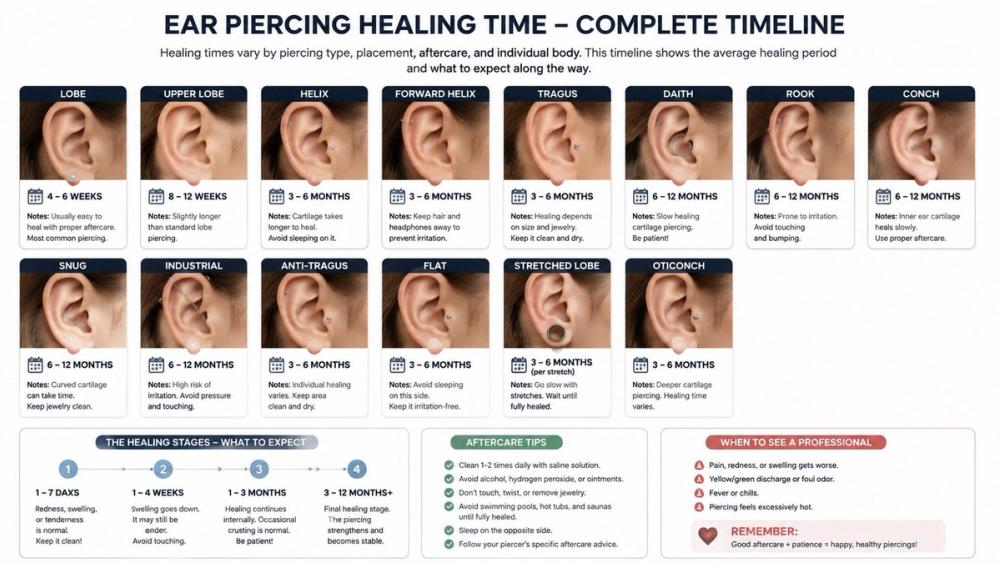
- Ask about healing time - cartilage names (rook, snug, daith) heal far slower than lobe names.
Ear Piercing Names vs. Types vs. Placements
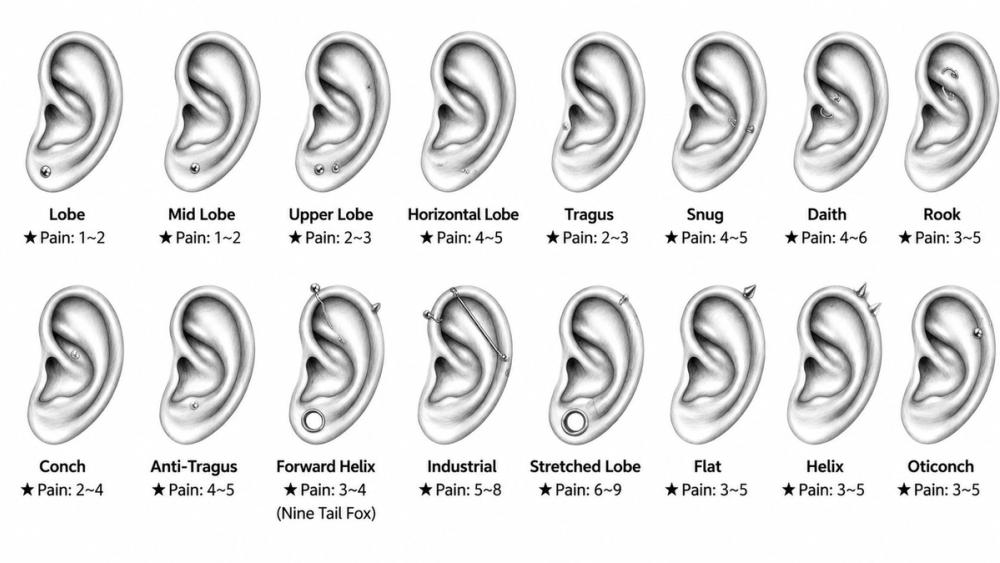
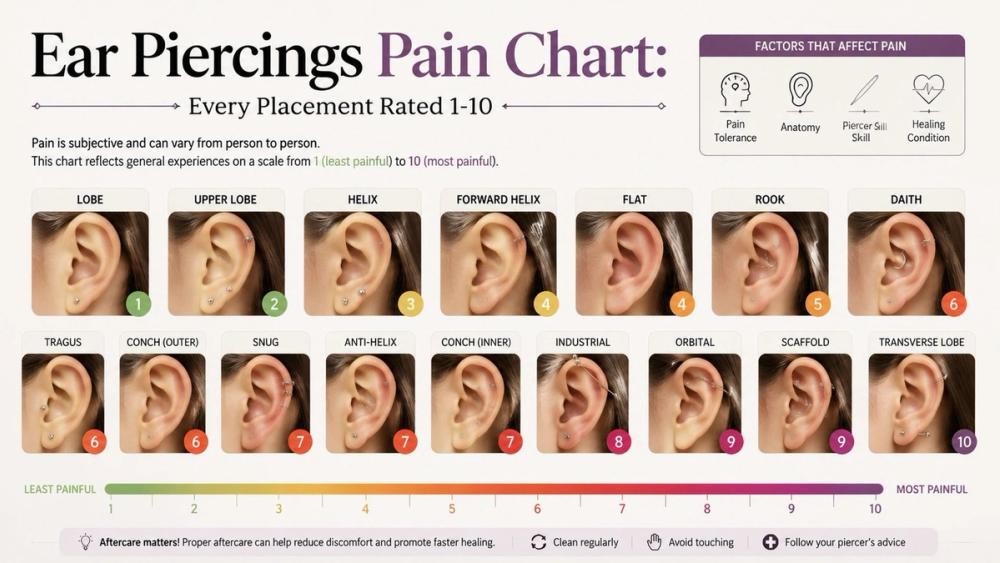
This glossary is about the names. If you want the visual map of where each one sits including pain levels and healing times see our ear piercing chart . And if you would rather browse every option grouped by region (lobe, helix, inner cartilage) with aftercare, our types of ear piercings guide covers it. Together they are the fastest way to go from "what is it called?" to "where do I want it?"
Frequently Asked Questions
What is the most common ear piercing name?
Lobe (or "earlobe") is the most common name, followed by helix. Both refer to the soft lower lobe and the outer upper rim respectively.
Why is it called a "daith"?
Daith comes from the Hebrew word for "knowledge" and was coined by the piercer who popularized it. It refers to the cartilage just inside the ear canal.
Is an industrial the same as a scaffold?
Yes - "industrial" (US) and "scaffold" (UK) describe the same two-hole, single-barbell piercing, typically through the helix and forward helix.
What is the difference between a snug and an anti-helix?
Nothing anatomical - "snug" is the nickname for an anti-helix piercing, a horizontal pass through the inner cartilage fold.
How do I pronounce "tragus" and "conch"?
Tragus is "tray-gus"; conch is "konk" (like the shell). Most piercers will know what you mean even if your pronunciation slips.
Find a Studio That Knows the Names
Once you have picked a name, the next step is finding a piercer who gets it right. PiercingNear lists vetted ear piercing studios across the US - search by city and book with confidence. Explore our directory to find a shop near you.